AS/NZS 3000 in plain English for Adelaide homeowners
The Wiring Rules are why a bathroom socket sits where it sits. They are not a personality, and they are not a substitute for a licensed electrician with a certificate.
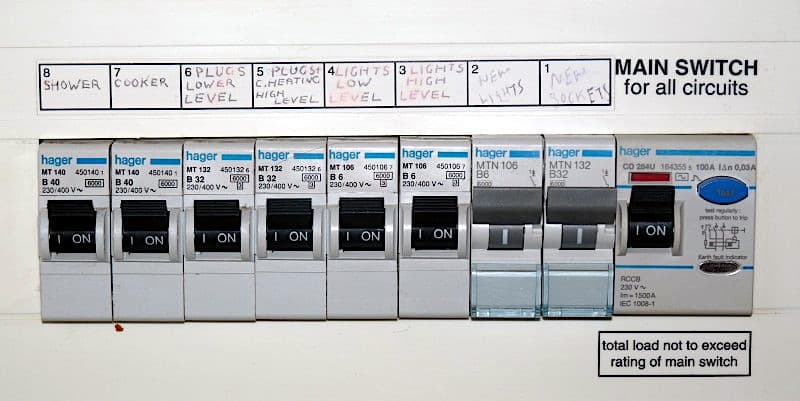
Photograph: Pfnicholls. Licence: CC BY-SA 4.0. Source on Wikimedia Commons. Also listed on our image credits page.
I get asked to “just explain the wiring rules” the way people ask a GP to explain the human body in the car park. AS/NZS 3000 — the Australian/New Zealand Wiring Rules — is a long technical document written for people who design, install and verify electrical installations. It is not a vibe, and it is not a pamphlet. What a homeowner can usefully hold is a map: what the standard is for, which rooms make it suddenly personal, and which questions are fair to ask before anyone chases a wall.
This is that map. It is not the standard. If a guest writer or a training desk ever tries to sell you a shortcut that pretends otherwise, this journal’s write for us page is where that pitch goes to die. I hold a licence and I still open the book. You should not have to.
A standard, not a mood
The Wiring Rules exist so that an installation in a Prospect bungalow and an installation in a new Mawson Lakes townhouse are judged against a shared technical language. South Australia applies that language through its technical regulator, the Office of the Technical Regulator. The licence to do the work sits with Consumer and Business Services. The paper that says a particular job was finished sits on a Certificate of Compliance. The standard is the thing those other documents are pointing at.
People talk about “code” as if it were a single sentence. It is not. The Rules deal with how an installation is designed, how it is put together, and how it is tested before anyone is invited to treat it as finished. They sit beside other standards for particular equipment — residual current devices, solar inverters, appliances — and beside the network operator’s rules for what happens on SA Power Networks’ side of the meter. A homeowner does not need the stack. A homeowner needs to know that the stack exists, and that “my last house was done like this” is not a clause.
I will not invent clause numbers here. Numbers look like authority and go stale. If you need a numbered answer, that is a site visit and a current copy of the document, not a journal essay.
What the Wiring Rules actually govern
Think of the house as an installation, not as a collection of gadgets. The Rules care about how the supply is arranged, how circuits are divided, how they are protected against overcurrent and against earth leakage, how they are earthed, how cables are chosen and supported, and how the finished work is verified. They care about isolation — the ability to make a circuit dead and to prove it. They care about the environment: heat in an Adelaide roof space, moisture in a Glenelg laundry, dust in a shed, sunlight on an outdoor socket.
That is why a careful electrician talks about more than the thing you can see. A new oven is a load, a cable size, a protective device, an isolator, a connection method and a test at the end. A ceiling fan is not “a bracket and a pretty switch”. A shed sub-board is not a jam jar of connectors, which is the sentence this journal’s rules hub already uses because it keeps being true.
The Rules also care about what happens when something fails. Protection is not a personality trait of the house. It is equipment chosen so that a fault to earth is detected, so that a cable is not asked to carry more current than it can, so that a person in a wet room is not the last insulating object in the circuit. When we write about fuse boards and residual current devices, we are writing about one visible corner of that idea.
Bathrooms, outdoors and the rooms that scare people
Wet areas are where homeowners meet the standard without meaning to. A bathroom is divided, in the technical language, into zones that depend on the bath, the shower and the reach of water. Those zones decide where a socket may go, what kind of accessory is allowed, and how lighting is arranged. The homeowner version is simpler: the room is wet on purpose, and the placement that looks neat on a Pinterest tile layout may be illegal in the actual room.
I am not going to draw you a zone diagram from memory and call it law. The diagram belongs in the current standard and in the electrician’s head on the day. What you can usefully say is: do not buy the socket first and then look for a wall. Hire the licensed person before the tiler wants an answer in twenty minutes.
Outdoor power is the Saturday version of the same problem. Adelaide uses its outdoor rooms. A socket on a verandah, a circuit for a pool area, a light over steps — each of those sits in weather, and weather is an environment the Rules know about. Ingress protection, height, isolation, residual current protection and the dull question of how the cable gets through masonry without becoming a hose are all technical matters. They are also why owner-builders cannot treat the alfresco as a hardware-run.
Kitchens sit in between: water, metal, heat, and loads that did not exist when the house was wired for one oven and a kettle. The Rules do not care that the splashback is beautiful. They care whether the circuit can do the job.
Protection devices, not personality
A circuit breaker opens when the current is too high. A residual current device opens when current is leaking to earth — including, in the worst case, through a person. An RCBO combines those ideas in one device. Older Adelaide boards have ceramic fuses and a main switch and a kind of optimism. Newer boards have a row of devices and a label that still matches the rooms. The Wiring Rules are why the second board is not merely fashionable.
Surge protection, isolation switches beside appliances, and the way neutrals are arranged in older houses are related conversations. They are not things to “have a go at” after watching a video. Isolation, in particular, is a safety act. This essay will not tell you to work live. It will not tell you to prove a circuit dead with a wet finger. If a device has tripped and you do not know why, the next step is not to hold it in.
Verification is the unglamorous end of the standard. Insulation resistance, earth continuity, polarity, residual current device testing — these are not optional ceremonies. They are how a licensed person becomes entitled to sign the certificate. If a quote has no time in it for testing, the quote has no time in it for the Rules.
The Wiring Rules are not a vibe. They are the reason a bathroom socket is where it is, and the reason a shed sub-board is not a jam jar of connectors.
What a homeowner can usefully ask
You can ask whether the work will be done to the current Wiring Rules as they apply in South Australia. You can ask how the circuits will be protected, and whether the existing board can accept the new load without pretending. You can ask how wet areas and outdoor points will be placed before the tiler and the concretor are committed. You can ask what will be tested and what the Certificate of Compliance will describe.
You can ask whether a heritage wall will be chased or whether the cable can travel another way. The standard is not an excuse to wreck a cornice, and a cornice is not an excuse to ignore the standard.
You cannot usefully ask for a clause number as a party trick, or for work that is “close enough because we are selling”. The next owner inherits the installation. So does the regulator’s file.
What the standard does not do
AS/NZS 3000 does not make you an electrician. Reading this essay does not make you an electrician. An owner-builder approval does not make you an electrician. The standard does not tell you to back-feed the grid from a generator, and neither will I. It does not tell you that a Facebook consensus about bathroom heaters is a design.
It does not replace SA Power Networks when the fault is on the street. It does not replace 000 when there is fire or a person injured. It does not replace a licence search at Consumer and Business Services. It is one document in a civic stack, and the stack is the point.
If you want the neighbouring pieces, start with the certificate, the licence check, and the owner-builder essay. If you want a numbered argument about a particular bathroom, book a licensed person, let them see the room, and let them work to the current book. I still do.
Questions readers send the desk
- Do I need to buy AS/NZS 3000 to renovate a bathroom in Adelaide?
- No. You need a licensed electrician who works to the current Wiring Rules as they apply in South Australia. The standard is a technical document, not a homeowner manual.
- Is a safety switch the same thing as the Wiring Rules?
- No. Residual current devices are one of the protections the rules expect in a modern house. The standard also covers earthing, isolation, cable selection, wet-area placement and verification of the finished work.
- Can an owner-builder follow the standard and skip the licence?
- No. Reading a standard does not authorise prescribed electrical work. South Australia still expects a licensed person and a Certificate of Compliance.