From fuse boards to RCDs: when an Adelaide switchboard is past its use-by
A laundry cupboard with ceramic fuses is not a heritage feature. It is a record of every circuit added since the house was last taken seriously. This essay sets out when an Adelaide switchboard has reached its use-by, what an RCD or RCBO actually does, and why a pretty door does not clear a fault.
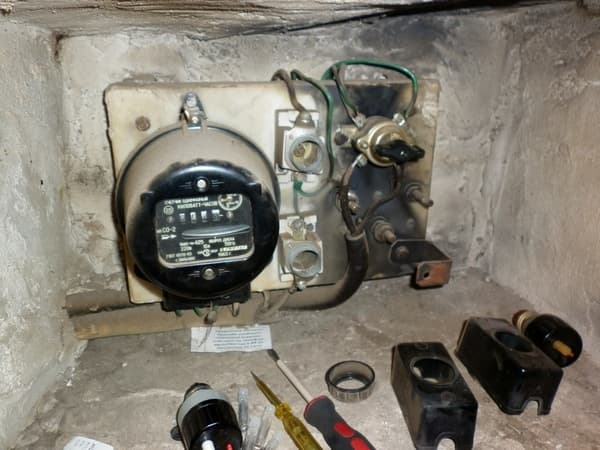
Photograph: ktulu87. Licence: CC BY-SA 3.0. Source on Wikimedia Commons. Also listed on our image credits page.
The first thing a licensed electrician looks at in an Adelaide house is rarely the kettle. It is the cupboard. In a 1960s brick veneer through Campbelltown or Modbury that cupboard is often in the laundry, painted the same cream as the trough, with a hinged lid opened by every owner since fuse wire was still sold on cards. In an Unley bungalow it may sit in a hallway niche. In a Norwood villa it is sometimes still on the back verandah, in a metal enclosure that has seen more summers than the present kitchen.
What the lid hides is not character. It is a chronology.
What the cupboard is actually telling you
A household switchboard has to tell a consistent story: incoming supply, main switch, earthing arrangement, then the final subcircuits for lights, sockets, the oven, the hot water and whatever arrived with the split system. In South Australia that story is supposed to include a Multiple Earthed Neutral — the MEN link — so earth and neutral are bonded at the main board in the way AS/NZS 3000 expects. If the story is a jumble of ceramic bodies, a later row of miniature breakers, a solar isolator squeezed in on its side, and a label written in pencil in 1974, the house is asking to be read, not admired.
Western-suburbs cavity brick in Thebarton, Mile End and older Hindmarsh often hides the board in a porch that was never meant to stay dry. Hills timber places — Stirling, Crafers, the wetter folds of Belair — put the same problem in a different climate: condensation, longer runs, a roof space that behaves like a forest. None of those houses fail in the abstract. They fail in the particular cupboard you can already name.
Fuses, breakers, RCDs and RCBOs
A rewireable fuse is a piece of wire chosen to melt. It will, if the current is high enough for long enough, open the circuit before the cable becomes a heater. It will not notice a person becoming the path to earth. It will not notice slow leakage into a damp laundry wall. Those are residual current problems, which is why residual current devices exist.
An RCD watches the balance between active and neutral. If some of the current leaves by a path it should not take — a person, a wet benchtop, a nicked cable in a cavity — the device opens. A typical domestic rating for personal protection is 30 milliamps. An RCBO packages that idea with overcurrent protection in one module. In a crowded Adelaide board the combination is how you stop adding devices that do not fit.
Circuit breakers without residual current protection are still common on older upgrades. They improve on fuse wire for overcurrent. They are not a safety switch. If a vendor says the board has been “modernised”, ask which circuits have RCD or RCBO protection, and ask to see the Certificate of Compliance from the licensed electrician who did the work. If there is no paper, there is no upgrade. There is a story.
A fuse that has not blown is not evidence of a safe circuit. It is evidence that the fault has not yet found a path the wire cannot survive.
The Adelaide stock, suburb by suburb
Unley bungalows and the neighbouring streets of Hyde Park and Millswood were wired in layers: cotton, then thermoplastic, then extra circuits for the dishwasher and the ducted system. The board is often still the original metal tray, restuffed so many times the labels no longer match the rooms. Rewiring those houses without wrecking the cornice is a separate essay — rewiring a 1950s Adelaide bungalow — but the board is usually the first honest invoice.
Norwood villas, and the masonry in Kensington and St Peters, add mass. Double brick and bluestone do not forgive a rushed chase. They also hide junctions made when the only test equipment on site was a lamp. A fuse board on a villa is often original because nobody wanted to open the wall to run new tails. That is not thrift. It is deferred work.
The 1960s brick veneers of the plains are more generous with voids and less generous with spare capacity. One main switch, a handful of fuses, then forty years of add-ons. Western-suburbs cavity brick has long TPS runs stapled through walls that have since been insulated, and meter boxes on the street front that have cooked in the western sun. Hills timber frames move. Boards in those houses need to be read with the climate, not against a catalogue photograph of a new plastic surround.
When the board is past its use-by
There is no sentimental date at which a fuse board becomes illegal to look at. There is a practical date at which it stops being a reasonable way to protect the people in the house. That date has usually passed if there is no residual current protection on socket circuits; if the only RCD sits at the head of everything, so a fault in the shed blacks out the house; if the main switch is a fuse; if the earth bar is a collection of untwisted tails; or if the MEN link is missing, painted over, or used as a spare terminal.
Heat is another confession: browned bakelite, a smell of warm dust when the oven and the kettle run together, a fuse carrier that has started to melt into its housing. Labels do not match rooms.
Those are not style notes. They sit beside the warning signs of an electrical fault that show up in the rooms — discoloured plates, buzzing dimmers, lights that sag when a motor starts. The board and the rooms are the same installation. One will usually confess first.
A wet meter box after a storm is another. Neutral faults in older South Australian homes often begin at the front of the house. If lamps glow when they should be off, or metalwork tingles, stop using the circuit and read neutral faults in older SA homes before anyone starts tightening things with the supply still on. Nobody on this desk will tell you to work live. A floating neutral is a good way to discover why.
What an upgrade is, and what it is not
A proper board replacement is isolation, testing, a new enclosure if the old one cannot take modern devices, a main switch, RCBOs or a coherent mix of RCDs and circuit breakers, a clean earth bar, a verified MEN connection, surge protection where the site warrants it, and labels a stranger could follow at night. The licensed electrician should test as AS/NZS 3000 and the South Australian rules require, then leave a Certificate of Compliance. You should see that paper.
An upgrade is not a new door on the old fuse tray. It is not a single RCD feeding a nest of unidentified circuits. It is not a weekend project with a video and a still-live service. Prescribed electrical work in this state belongs to a licensed electrician. The licensing and standards hub exists for the civic half of that sentence.
The upgrade also does not rewind the house. If the TPS in a western cavity is perished, or a Norwood villa still has junctions nobody can name, the new board will start to trip. That is the device doing its job. Owners sometimes treat those trips as a defect in the upgrade. They are more often a defect the fuses had been ignoring.
Paperwork, the MEN link, and after the lid goes back on
AS/NZS 3000 is not a mood. It is the wiring rules as applied here, and it is the reason residual current protection is now the ordinary expectation on the circuits people touch. A licensed electrician is not being precious when they refuse to leave fuse wire on a socket circuit because the owner likes ceramic. They are declining to certify a museum.
The MEN link deserves its own sentence. In the Australian earthing system, neutral and earth are bonded at the main switchboard. That bond is how fault current finds a reliable path. Board upgrades that skip the earth and neutral arrangement because “the fuses still work” have misunderstood the job. The switchboards and wiring hub collects the neighbouring essays; this one says the cupboard is allowed to be expensive if the alternative is a house that only looks finished.
You should be able to open the new enclosure and read it. Keep the Certificate of Compliance with the papers that survive a sale. If you are standing in front of a ceramic row and wondering whether it is good for a few more years, the years have already been used. A licensed electrician can isolate, test and tell you whether the next invoice is a board, a rewire, or both. That conversation is quieter than a fault, and it does not require anyone to work live to find out.
Questions readers send the desk
- Does a new switchboard door count as an upgrade?
- No. A painted lid or a plastic surround does not add residual current protection, does not relabel circuits, and does not produce a Certificate of Compliance. The protective devices and the MEN arrangement are the job. The door is joinery.
- Can I keep some ceramic fuses if the house is old?
- Sentiment is not a wiring method. AS/NZS 3000 expects residual current protection on the final subcircuits that people actually use. A licensed electrician can explain which ways stay, which go, and what the Certificate of Compliance will record. Leaving fuse wire because it looks original is not a plan.
- If the board is upgraded, do I still need the house rewired?
- Sometimes. A modern RCBO board will trip on faults the old fuses ignored, which is the point. It will not replace perished TPS in a western-suburbs cavity or cotton remnants in a Norwood villa. The board is one document. The wiring is another.