Bushfire-prone properties: ember attack, backup and switchboard siting
In the Adelaide Hills the electrical conversation is not only heat and heritage. It is embers at the meter box, a generator that must not sit in the leaf litter, and a board sited for a person who may have minutes, not an afternoon.
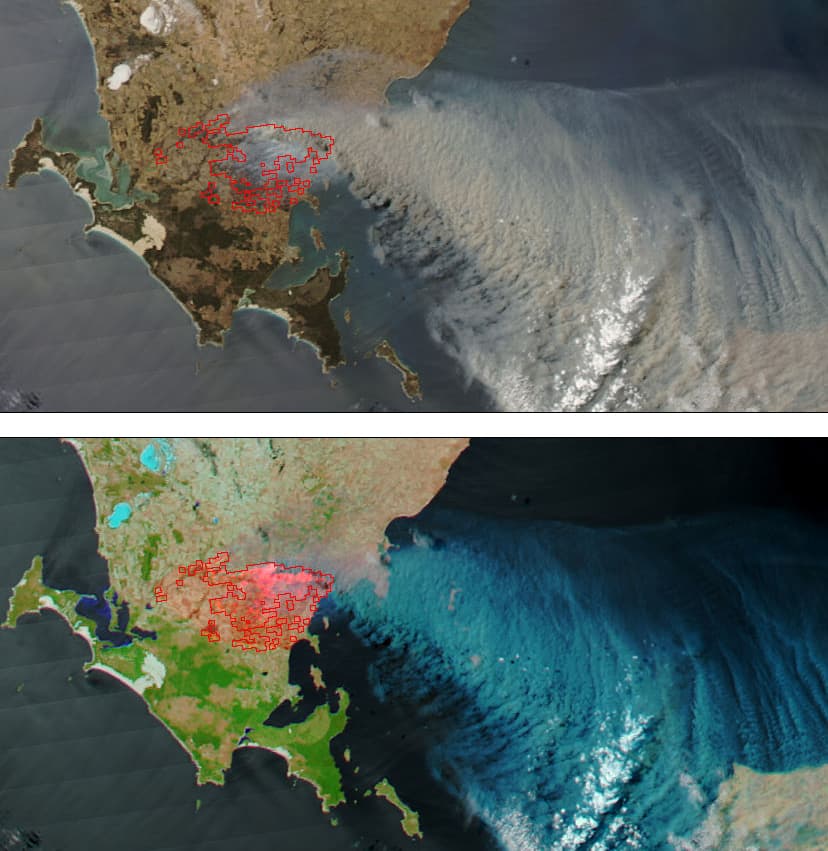
Photograph: NASA / User:Diceman. Licence: Public domain. Source on Wikimedia Commons. Also listed on our image credits page.
The Adelaide Hills are not a mood. They are a set of materials and a set of winds. Timber houses in Stirling and Crafers sit among stringybarks that drop litter into every ledge. Aldgate adds wetter winters that make people forget the dry. Blackwood, lower and more suburban, still has enough slope and canopy that a warning day is not theoretical. This is the other half of the Adelaide houses story. The plains bake. The Hills can burn.
I am not going to pin a Bushfire Attack Level to a street. BAL is a calculation for a site: vegetation, distance, slope, the way fire weather leans on a particular ridge. Two houses in the same Crafers lane can come out differently. Anyone who quotes a number because the suburb sounds leafy is guessing.
What I can write about is the electrical edge of ember attack. Embers are the ordinary way houses light. They travel ahead of the front and look for a gap. A meter box is a gap with a hinge. A switchboard under an unsealed eave is a gap with plastics in it. A generator parked in the leaf litter is not a gap. It is a decision.
BAL in plain language
Think of BAL as a way of saying how hard the fire is allowed to try your house. At the lower end the conversation is embers and radiant heat at a distance. At the higher end it is flame in close and a construction argument well beyond electrics — cladding, decks, windows, the underside of the verandah. The electrical part sits inside that argument. It does not replace it.
A designer who understands bushfire country will ask where the meter and the board live, how the enclosure is sealed, what it is made of, and whether a person can reach the main switch without standing in the hottest place on the lot. Those are siting questions. They belong in the first sketch, not after the kitchen is tiled.
Hills timber is unforgiving here. Weatherboard and later sheet products give you voids, which is a gift for running cable and a problem for embers. Brick veneer — common as you drop toward Magill and the foothills streets that think of themselves as plains — gives you a cavity that must be detailed. Double brick and stone are rarer up the ridge, more common when the same owner also has a Walkerville or North Adelaide place and assumes masonry is automatically safer. Masonry helps. It does not seal a plastic enclosure that has warped in last summer’s forty-five-degree heat.
Embers do not need a dramatic front. They need a hinge that does not quite close and a weekend of northerly wind.
Meter boxes and the face of the house
The meter box is a network object and a household object. SA Power Networks has opinions about access and height. The house has opinions about weather and appearance. Bushfire country adds a third opinion: the box is an opening in the envelope. A lid that does not latch, a hole where a cable entered and was never made good, a nest of leaves along the top flange — these are ember paths. They are also the kind of defect a careful electrician will point at during an otherwise ordinary board upgrade.
I will not tell you that every Hills house must have a particular brand of metal enclosure. Plastics cook, warp and, in a bad hour, become part of the fire. Metal boxes still need intact seals. A box sited on the fire-exposed face because that was the shortest path to the pole will be unpleasant to open on the day you most need the main switch. If there is a choice — and on a new build or a serious alteration there often is — put the enclosure where a person can reach it with the house between them and the likely run of fire.
Switchboard siting inside the house is the quieter decision. Laundry cupboards are the Adelaide default. In a timber Hills house the laundry may be a later lean-to with a thin door and a lot of stored paint. A board that can only be reached by wading through that is a board that will not be isolated quickly. Relocating a board is disruptive and expensive. It is still cheaper than a story that begins with “we could not get to the switches”. The work is prescribed. A licensed electrician does it. You should see a Certificate of Compliance.
Readers who arrived here from a plains villa should still read the switchboard hub. A ceramic fuse board in a Crafers laundry is not charming. It is a delay. Residual current protection and clear labels are safety equipment. In bushfire country they are also time.
Generators, inlets, the idea of backup
Warning days and outage days are not the same day, but they visit the same households. A portable generator that lives in the shed all year and comes out when the lights die is a common Hills plan. It is a plan that kills people when it is done wrong. Exhaust in an enclosed space. Fuel near a hot muffler. A lead through a doorway that is also an ember path. A connection that back-feeds the street and turns a fallen line into a surprise for someone in a hi-vis shirt.
The housing version of this advice is about placement and intention. A generator needs a hard, cleared pad that is not the timber deck and not the leaf-filled corner of the carport. It needs exhaust pointed away from openings and away from the wall that holds the meter. It needs a licensed changeover or inlet arrangement so the house is either on the network or on the machine, never both. That arrangement is electrical work. It is not a plug the neighbour “has used for years”.
Fixed backup — a standby generator, a battery that has been designed as more than a bill-saver — belongs in the same siting conversation as the board. Clearance from vegetation. Access for service. An enclosure that does not become a kiln in January and a nest in June. I will not invent a setback in metres for a Stirling driveway. I will say that if the installer cannot explain clearance, exhaust and isolation in ordinary sentences, you do not have an installer. You have a brochure.
Ember-proofing around the board
The unglamorous work is seals, screens and housekeeping. Cable entries that were oversized and never filled. A gap at the bottom of a box where the cladding never quite met the flange. Vents that must be screened rather than blocked with glovebox foam. A licensed electrician and, on a higher BAL site, the person who signed the bushfire report should agree on what “screened” means. Blocking a vent because you are frightened of embers is how you cook the equipment you were trying to save.
Housekeeping is not electrical work and it is not beneath the subject. Leaves on the meter flange, mulch piled against an external board, a wood stack under the verandah that holds the inlet — these are owner decisions. They sit beside the outdoor power habits that already matter on the plains: the right enclosure, residual current protection, no amateur festoon into dry grass. In the Hills the same festoon is a prettier fuse.
Internal boards need a clear metre of decision-making, not décor. If the cupboard is also the linen press, accept that in a bad hour someone will be throwing towels on the floor. If the board is in a workshop that smells of solvent, move the solvent. None of that requires a licence. The moment you start moving the board itself, you are back with the electrician.
After a warning day, after a fire
If the fire stayed in the next valley and the house only ate smoke, do not assume the electrical system is unchanged. Heat and fine ash find connections. A meter enclosure that sat closed through an ember shower should be looked at by a licensed person before you treat it as ordinary. If there is damage, a smell, or a breaker that will not sit, you are in the safety column. Flame, smoke in the living rooms, a board that is obviously cooked — leave, and call 000 if the event is still live.
Rebuilding is a chance to site things the last builder sited for convenience. Ask where the board, meter and inlet will be, and how the roof space will be sealed around penetrations. Ask for the Certificate of Compliance, and keep it with the BAL assessment. A Hills house is a stack of documents as much as timber. The ones that last treat embers as a design condition, not as a story that happens to other ridges.
Questions readers send the desk
- Does a high BAL rating mean I need a metal meter box?
- BAL is a site assessment, not a shopping list I can recite from a suburb name. Higher attack levels generally push designers toward better-sealed, more ember-resistant enclosures and careful siting. A licensed electrician and, where required, a bushfire consultant read the assessment for your lot. Do not guess a number from the street sign.
- Can I leave a portable generator on the verandah all summer?
- A generator needs clear exhaust, dry footing, distance from combustibles and a changeover arrangement that cannot back-feed the street. Leaving it among leaves on a timber deck is how a backup plan becomes an ignition plan. Placement is part of the electrical and fire conversation, not a Saturday afterthought.
- Who issues the Certificate of Compliance after bushfire-related electrical work?
- A licensed electrician issues it when the work is prescribed — a new board, a generator inlet, bonding, a relocated meter enclosure. The certificate is the record. Keep it with the other papers a conveyancer will one day ask to see.