Electrical systems in a 45-degree Adelaide summer
On a plains heatwave the roof space is another climate, the air-conditioner is a starting current, and the outdoor socket that looked fine in September becomes a UV-brittle hinge. Heat is a design condition here, not a surprise.
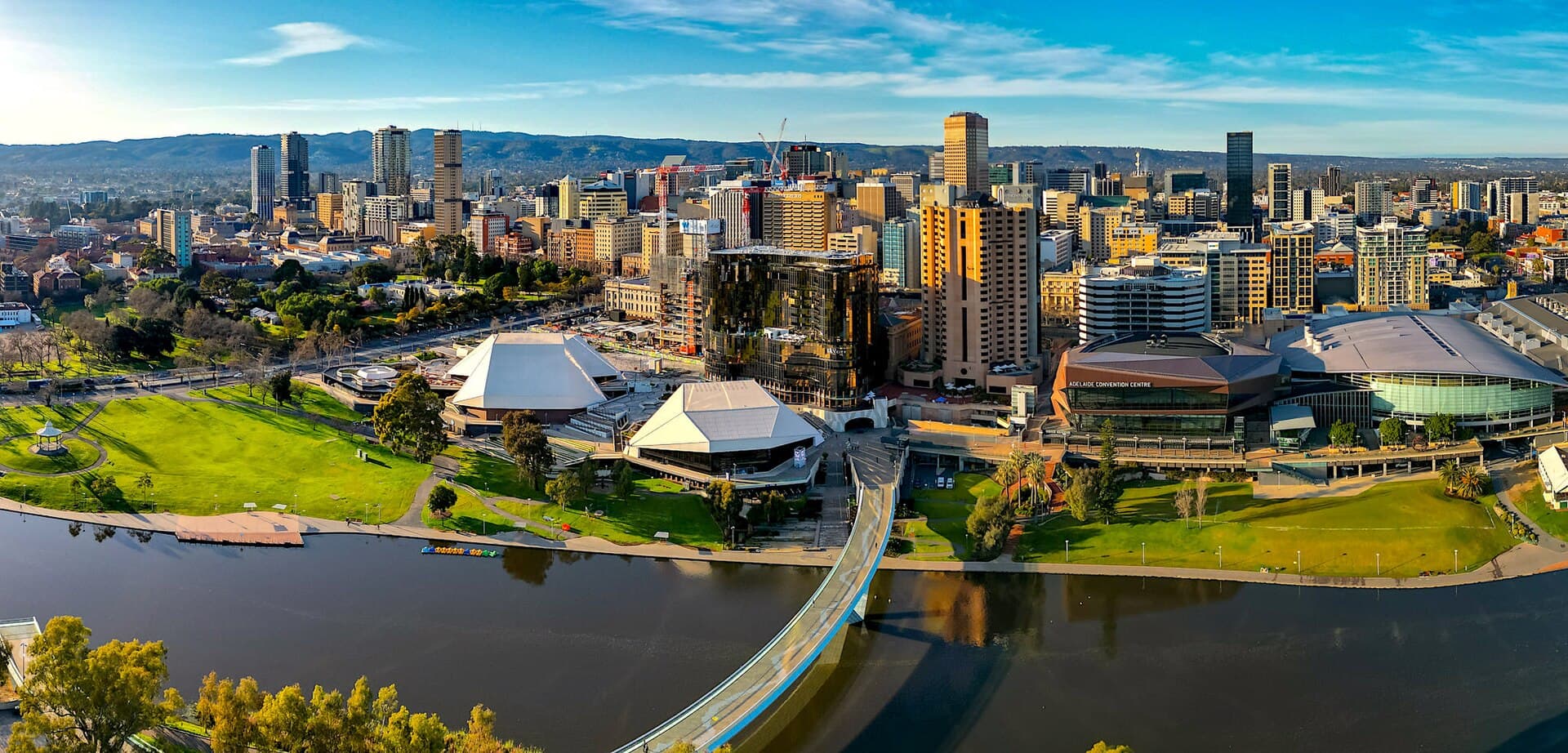
Photograph: Ardash Muradian. Licence: CC BY-SA 2.0. Source on Wikimedia Commons. Also listed on our image credits page.
Adelaide in midsummer rearranges its furniture. Blinds go down on the western wall. The plains suburbs — Unley through to Magill, the western beaches at Glenelg and Henley Beach, the older streets behind Port Adelaide — sit under a sky that has stopped being decorative. Forty-five degrees on the Stevenson screen is a number. The number that matters to a house is the one in the roof space, which has no screen and no manners.
This is a housing essay, not a meteorology one. The houses of this city were built for a different idea of heat: thick masonry in the inner ring, deep verandahs, a roof that was allowed to be a void. They were not built for a ducted system, a second split, a pool pump, an inverter and a kettle that all want the same afternoon. Electrical systems fail in February the way stone fails in a flood. The weakness was always there. The season finds it.
The roof space is another climate
Crawl into an inner-suburban roof in September and you will meet dust, old TPS, and timber that has been dry for decades. Crawl into the same roof on a north-wind day in January and you will meet a climate. Dark tiles over a shallow sarking can run tens of degrees hotter than the street. I will not pin a figure to a particular Unley bungalow or Glenelg masonry; every roof is a stack of colour, insulation and luck. Cable ratings assume an ambient. Connections assume a torque that heat then undoes. Downlights assume a clearance that insulation has already forgotten.
Hills timber houses in Stirling, Crafers and Aldgate change the picture without cancelling it. The air is often a few degrees kinder. The roof can still be a kiln if the gums take the breeze and the sarking is old. Blackwood, lower and more suburban, sits between the two: brick veneer, a tight eaves, and a roof space that was never meant to host an inverter and a nest of extra circuits.
Anything you store in that climate — and an inverter is a stored object that happens to make electricity — should have been chosen for it. A lot of the early rooftop years in South Australia put inverters in the hottest cupboard because the cupboard was close to the array. Close is not the same as wise.
A roof space on a north-wind day is not an attic. It is a climate that happens to contain your wiring.
Air-conditioning is a load with a personality
Adelaide did not become an air-conditioned city evenly. Double brick and bluestone in North Adelaide and Walkerville hold the night longer; people there still argue about whether a split system is a moral failure. Brick veneer on the plains does not hold the night. By two in the afternoon the western rooms are asking for a compressor. The compressor asks the board for a starting current that is not the same as the running current on the brochure.
A licensed electrician sizes a circuit for the real start, the real run, and the real length of cable. A house that grew a second head unit from a hallway powerpoint did not get that conversation. On a mild day the arrangement limps. On a forty-five-degree day the lights dip, and someone decides the switchboard is “a bit tired”. Tired is not a diagnosis. Undersized cable, a shared circuit, a loose neutral, ceramic fuses — those are diagnoses. They require isolation, testing and, when the work is prescribed, a Certificate of Compliance. They do not require a homeowner to open a live lid.
Ducted systems and large heat pumps are why some later houses already have three-phase and why some earlier ones are being asked to grow it. Three-phase is not a personality upgrade. It is a supply decision that involves the network as well as the board. If the quote for summer comfort begins with a new outdoor unit and never mentions the board, the quote is a fragment.
Sagging voltage, busy streets
Heat does not only live in your roof. It lives on the street. Long runs of suburban mains, neighbourhood air-conditioners starting within the same hour, and a solar fleet that is exporting or sulking depending on the cloud — these move the voltage at the meter in ways a kettle does not. Lights that brown when the compressor starts may be telling you about the house. They may be telling you about the street. A licensed electrician can measure. A neighbour’s anecdote cannot.
Voltage rise from rooftop solar is the cooler-months version of the same argument. In high summer the common complaint is sag under load, late afternoon, when the western walls are still radiating and the array has come off its peak. The two problems can live in the same board. A summer visit is not a look at one breaker. It is a look at a house asked to be a small power station and a small hotel at once.
If the house is in the Hills, add bushfire-prone properties and the question of what still runs if the network drops you on a warning day. Backup designed for a blackout weekend is not automatically safe to start when the paddock is a tinderbox.
Outdoor sockets, verandahs, the western wall
The outdoor powerpoint is Adelaide’s most optimistic object. It is installed on a clear September Saturday, often on a western wall because that is where the barbecue stands. By February the cover has gone chalky, the hinge has a memory, and the socket that faces the setting sun runs hotter than the one in the laundry. UV and heat make plastics brittle. Salt air at Glenelg, Henley Beach and the Port Adelaide waterfront makes metal fittings sulk. A cover that no longer closes is not cosmetic. It is an enclosure that has stopped being an enclosure.
This is adjacent to the alfresco, pool and outdoor power problem, and it is also a summer problem of its own. Extension leads under a tablecloth, festoon lighting daisy-chained from a hedge-trimmer socket, a portable cooler in meltwater — these are how a heatwave becomes an incident. The fix is a weatherproof outlet of the right rating, on a circuit with residual current protection, installed by a licensed electrician who isolates the board before they open anything.
Verandahs on heritage masonry deserve a particular note. A sandstone or bluestone face does not want a new box cut into it because the barbecue moved two metres. Surface mounting, a discreet conduit, a point taken through a later timber addition — those keep the stone. Heat does not excuse a chase. Heat makes a bad chase worse, because the make-good dries too fast and lets go.
Inverters that live in the kiln
South Australia grew up with rooftop solar early enough that a lot of inverters are now middle-aged. The ones parked in roof spaces are having a harder middle age than the ones that got a garage wall and a little shade. Heat derates output, shortens the life of electrolytic parts, and produces error lights that owners photograph for group chats. None of that is a DIY relocation. An inverter move is electrical work, often a network and isolation question, and it ends with paperwork when the work is prescribed.
If the inverter is in the roof because “that is where the last people put it”, treat that as history, not a constraint. A summer visit should ask about ambient, and about whether you can turn the system off without standing on a forty-five-degree roof, whether the labels still match, and whether the isolator itself has cooked. A brittle isolator is not a character feature. Batteries have their own temperature opinions. A brochure written for a temperate climate is not a design for an Adelaide January.
What a summer service visit is for
A useful visit on a heatwave week is mostly listening and measuring. Which rooms dip. Which breaker warms. Whether the outdoor unit short-cycles. Whether the board smells like dust or like something newer and worse. The electrician isolates before they remove covers. You do not hold the torch inside a live board because you are curious. If there is smoke or a persistent hot smell, leave, and call 000 if flame is involved. The rest of us can wait for a licensed person and a Certificate of Compliance.
The habit this city needs is to treat heat as a design condition, the way we already treat heritage fabric and, in the Hills, ember attack. A house that is comfortable on the twelfth of January is a house whose circuits, enclosures and roof-space decisions were made with that day in mind. The ones that were not will keep introducing themselves every summer.
Questions readers send the desk
- Why do lights dip when the air-conditioner starts on a hot afternoon?
- Compressors draw a short, heavy starting current. On a long run from a modest board, or on a street already sagging under neighbourhood load, that start can show as a brown dip. It is a reason to have a licensed electrician look at the circuit and the supply, not a reason to ignore it.
- Is a hot roof space a reason to put the inverter in the garage?
- Often, yes. Inverters derate as they heat. A unit cooking under dark tiles on a forty-five-degree day will quietly make less power than the brochure. Relocation is electrical work. It needs a licensed electrician and, when the work is prescribed, a Certificate of Compliance.
- Can heat alone trip a safety switch?
- Heat stresses insulation, connections and residual current devices. A trip that only happens on the worst afternoons is still a trip. Treat it as a fault to be found, not as the weather being dramatic.