Safety switches and RCDs: what Adelaide homeowners still get wrong
A safety switch is a measuring instrument that happens to live in the laundry. Most Adelaide boards still treat the test button as sculpture, and a trip as a personality flaw.
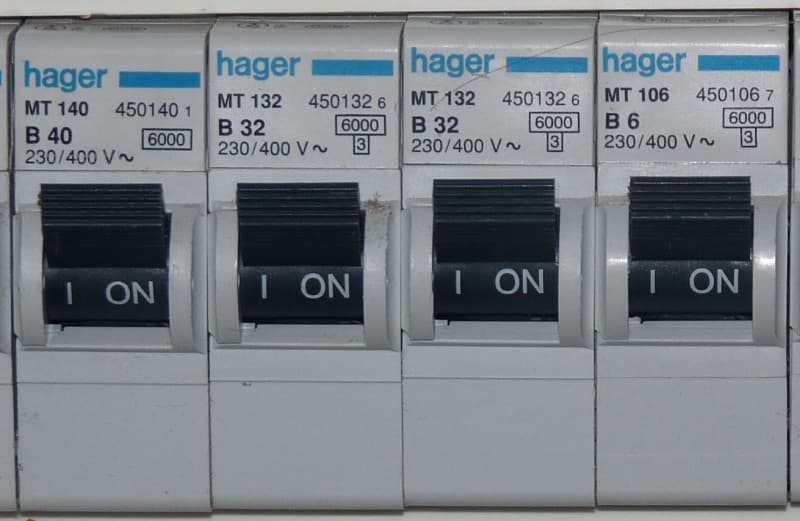
Photograph: Pfnicholls. Licence: CC BY-SA 4.0. Source on Wikimedia Commons. Also listed on our image credits page.
The test button on a safety switch is not decoration. It is the cheapest diagnostic instrument in the house, and most Adelaide boards still treat it as optional sculpture. People will spend a Saturday arguing about solar export and never put a finger on the small “T” that tells them whether the device that is supposed to open on a leak can still move.
A residual current device watches the current leaving on the active and the current coming back on the neutral. If those two numbers disagree by enough — conventionally 30 milliamps on a domestic circuit — the device opens. It is not reading your mind. It is not “too sensitive” because it objects to a hedge trimmer in wet grass. It is doing the arithmetic AS/NZS 3000 asked it to do. The Office of the Technical Regulator did not invent that number for sport. Bodies start to fibrillate at currents not much larger, and they do it in laundries that look perfectly ordinary.
This essay is about the mistakes that keep turning up in Unley villas and Salisbury brick veneers: boards with one RCD for the whole house, test buttons that have not been pressed since the last sale, trips that get reset like a modem, and a lingering confusion between a safety switch and a circuit breaker. It is not a licence to work live. Prescribed electrical work still belongs to a licensed electrician, and the paper at the end is still a Certificate of Compliance.
Three devices, three jobs
Homeowners use “safety switch” for everything in the board that has a toggle. The board does not.
- A miniature circuit breaker (MCB) opens on overcurrent. Too many amps, a short between active and neutral, a seized motor. It is the modern fuse. It will not reliably save you from a live toaster sitting in a puddle.
- A residual current device (RCD) opens on imbalance. Leakage to earth, a person, a damp outdoor fitting. It may sit upstream of several MCBs, which is how one damp garden light turns off the fridge.
- An RCBO is both jobs in one module: overcurrent and residual current, usually one circuit at a time. When it trips you know which room is talking.
Rewirable fuses are the older cousin. They still live in laundries through Prospect and Thebarton, ceramic bodies and a bit of wire that was last sized by whoever had the fuse wire card. A fuse can open on fault current. It is slow about leakage. If your “safety switch” is a fuse, it is not a safety switch. The upgrade conversation is in fuse boards to RCD protection, and it is a licensed job, not a Saturday with a screwdriver.
Labels matter. A board that still says “POWER 1” in fading marker, with one RCD at the top, is a map of a particular era. A later stack of RCBOs is a different document. Neither is automatically safe. Both can be read.
The board with one RCD for the whole house
This is the most common Adelaide misunderstanding. An owner in Norwood or Goodwood will say “we already have a safety switch” and mean a single device that feeds every power circuit, and sometimes the lights as well. When it trips, the house goes dark, the fridge starts a thaw, and the owner decides the switch is a nuisance. The switch is reporting. The design is the nuisance.
A single upstream RCD is a blunt instrument. It is better than nothing. It is also why a cracked outdoor powerpoint at Glenelg, full of salt and afternoon sprinkler, can take out the bedrooms. Moisture, a failing element in a storage heater, a fridge with a weep to earth: any of those will look like “the whole house is faulty”. Isolate what you can unplug. Note what was on. Do not keep resetting it through dinner to see if it settles.
Modern practice, and the direction AS/NZS 3000 has been walking for years, is to split protection: separate RCDs for different final subcircuits, or RCBOs so a single leak does not black out the dwelling. That work is prescribed. It means isolation, testing, and a Certificate of Compliance. Consumer and Business Services will want the electrician’s licence to be real. A pretty new door on the same old single RCD is a cosmetic.
Henley Beach eats the outdoor circuit. Mawson Lakes will show you a neat plastic board that still funnels everything through one device because the builder’s pack said so. Burnside masonry makes the upgrade slower. One RCD is a starting point, not a personality.
The test button is a monthly habit
Manufacturers and Australian guidance have said the same thing for a long time: test residual current devices regularly, and monthly is the interval worth keeping. You press the test button. The device should trip. You reset it. If it does not trip, the mechanism may be stuck, the electronics may have died, or the device may never have been a functioning RCD. Stop relying on it. Book a licensed electrician. Do not start dismantling the module to see the spring.
People skip the test because they do not want to reset clocks. That is a real inconvenience and a poor reason to leave an untested device in charge of a wet laundry. An unlabelled board is itself a finding. A licensed electrician can label as part of other work; you should not peel the fascia off to guess. Pushing “T” confirms the mechanism can open. Insulation resistance and fault-loop tests are the electrician’s.
A trip is not a mood. It is a measurement that happened faster than you could feel the fault.
Why a trip is information
The second big mistake is treating a trip as an insult. The device opened. Something was unbalanced. Your job is to treat that as data.
If it trips when a particular appliance goes in, leave that appliance out. A cracked kettle, a rusty outdoor radio, a fish-tank heater: ordinary villains. If it trips with everything unplugged, the leak is in the fixed wiring or a fixed appliance. That is a licensed visit, not a torch job.
If it trips after rain, look at outdoor fittings, the meter box, and anything on a verandah. After the storm covers dirty supply. If the whole street is involved, that is SA Power Networks. If it is your garden light and your RCD, it is your installation.
If it trips every afternoon in a heatwave, write that down. Heat opens tired joints and makes leakage paths more obvious. The warning signs of an electrical fault — warm plates, dipping lights, a burning-dust smell — often arrive in the same week as the “nuisance” trips. They are the same conversation.
Never work live to “find the tingle”. Never bypass an RCD with a link because the fridge must stay on. That last idea still gets suggested on Facebook as if it were folk wisdom. It is how people turn a protective device into a souvenir.
What a licensed electrician will actually do
A careful electrician will isolate, test and open. They will confirm that each RCD or RCBO trips on the test button and on an instrument. They will look for circuits that were never put on residual current protection — the old air-conditioner, the shed, the oven that was added through the side of the board. They will check that the neutral and earth relationships still make sense, which is where older Adelaide houses like to hide.
They should talk to you about splitting a single house-wide RCD, about RCBOs if the board can take them, and about whether the enclosure itself is the constraint. They should not talk only about “upgrading the look”. They should leave labels that match the rooms. They should leave a Certificate of Compliance for the prescribed work. If they cannot point you at a licence that Consumer and Business Services can find, they are not your electrician.
The switchboards hub is the longer version of that cupboard. The safety hub is the rest of the household picture: smoke alarms, child-safe circuits, the signs that mean you stop using a room. A safety switch is not a personality and it is not a subscription. It is a small electromechanical decision, made in milliseconds, on a leak you may never feel. Press the button. Believe the trip. Leave the live parts to someone licensed.
Questions readers send the desk
- How often should I press the test button?
- Monthly is the habit worth keeping. Press the test button on each RCD or RCBO, confirm that it trips, then reset it. If it does not trip, stop using the circuits it protects and have a licensed electrician investigate. Do not open the board to “see why”.
- Why does one trip turn the whole house off?
- Many older Adelaide boards put lights and power on a single residual current device. A damp outdoor point or a faulty kettle then takes out the fridge, the clock and the hallway. That is a design leftover, not proof that the device is too sensitive. An upgrade to several RCDs or to RCBOs is prescribed work for a licensed electrician.
- Is a trip the same as a blown fuse?
- No. A miniature circuit breaker or a fuse opens on overcurrent — too many amps. An RCD opens on imbalance between active and neutral, which is how it sees leakage through a person or a damp fitting. An RCBO does both in one module. Resetting the wrong story wastes time and leaves the leakage in place.